Introduction
When you think of programmers, what image comes to mind? Is it the scrolling green characters from “The Matrix” or a person in a flannel shirt, staring at a computer screen, furiously typing away due to a missing semicolon?
Programming has long been viewed as an insurmountable wall. For most people, developing their own software seemed nearly impossible—requiring memorization of tedious syntax, understanding complex logic, and configuring various frustrating environments.
However, in 2025, a new term emerged in the tech world—Vibe Coding. This is not just a trendy new concept; it represents a revolution that enables ordinary people to develop software.
It completely breaks down the “technical wall” that has kept countless ideas at bay, addressing a core pain point: transforming “writing code” into “stating requirements.”
What Does Vibe Coding Mean for Ordinary People?
For the average person, this means you no longer need to understand Java or Python, nor do you have to be that frustrated coder staring at a black screen. You can directly become a product manager or director. You only need to tell AI in plain language, “I want a software that looks like this,” and AI will help you write the code.
Some even say that with its emergence, Chinese (or English) has finally become the most popular programming language in the world. As long as you can speak, you can create software.
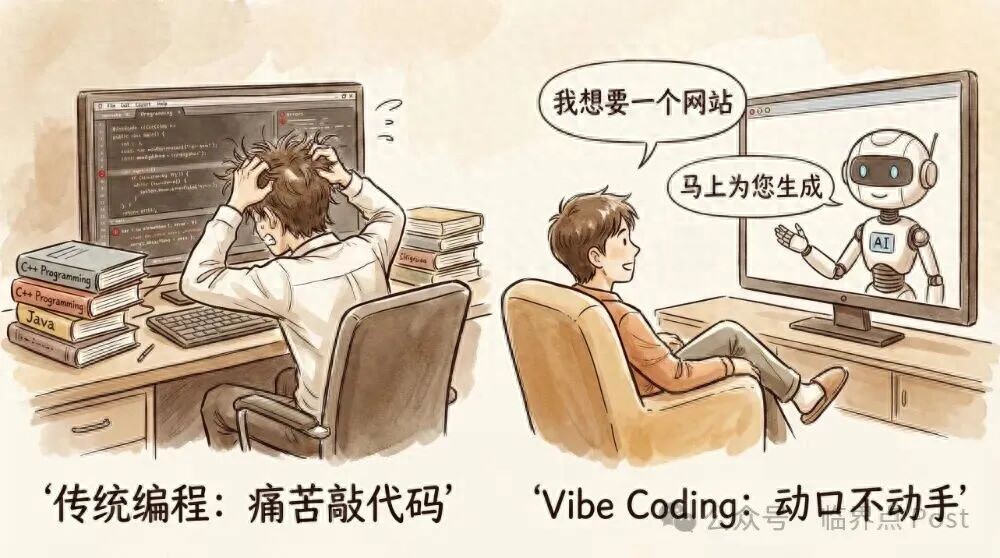
What is Vibe Coding?
In simple terms, Vibe Coding is a programming method that requires only verbal input, not manual coding.
Previously, writing code was akin to laying bricks; programmers had to carefully stack each brick, and if one was misaligned, the entire wall could collapse (resulting in an error).
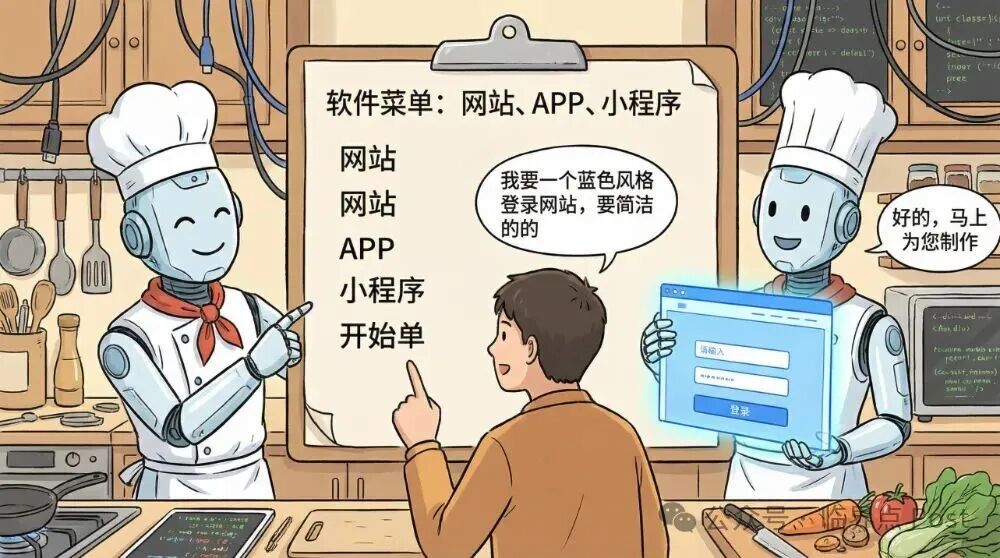
In contrast, Vibe Coding resembles ordering from a menu. You don’t need to know the recipe’s exact measurements or how the chef flips the pan. You simply tell the AI chef, “I want a sweet and sour pork with less spice and more green onions.”
Traditional Programming vs. Vibe Coding
- Traditional Programming: You need to research recipes, buy ingredients, chop meat, mix seasonings, and control the heat.
- Vibe Coding: You tell AI your needs, and it instantly serves up a dish (software).
At this point, you don’t need to check the chemical composition of the dish (review the code); you just need to taste it (run it) and provide feedback:
- “Hmm, it’s too bland”—you tell AI, “Add more salt.”
- “Hmm, the meat is too tough”—you tell AI, “Make it tender next time.”
This tasting process is the Vibe Check. As long as the program runs in a way that meets your expectations (Vibe), that’s all that matters! Who cares what the thousands of lines of code look like?
Ordinary People Can Become Super Individuals
The biggest impact of this change is not that programmers will lose their jobs, but that ordinary people gain superpowers.
In the past, if you were a doctor wanting to create a small software to track patient records, or a teacher wanting to develop an automated quiz website, you typically had two choices: either spend a fortune hiring someone or spend years learning to code.
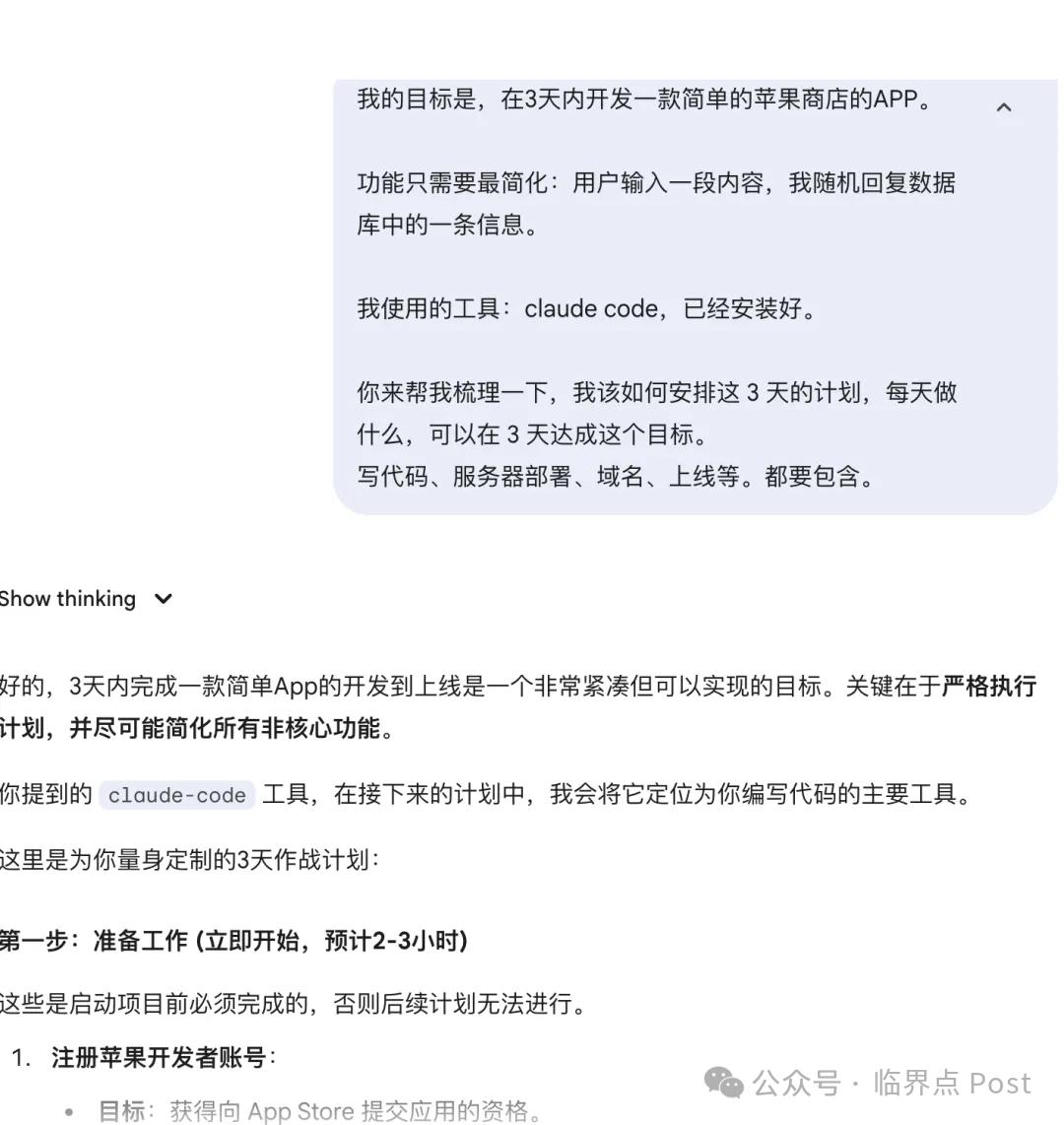
Now, with AI programming tools like Trae, Kimi Code, and Qoder CLI that integrate large models, super individuals are rising. For ordinary people, the operation is quite simple: just open these tools and input your ideas like chatting (e.g., “Create a to-do list webpage”), and AI will automatically generate the code and demonstrate the results.
A recent real-life example that gained significant attention is an app called demumu. This app is designed as a lightweight safety tool for people living alone. Its functionality is straightforward: users set emergency contacts and check in daily. If a user fails to check in for 48 hours, the system automatically sends an email to the contacts to confirm the user’s safety.
This application precisely addresses the emotional needs and concerns for the living conditions of young people living alone.
What’s even more surprising is its development process: it was created by three individuals born in the 1990s in just one month, with a total development cost of only about 1000 yuan.
Before Vibe Coding, such stories were nearly unimaginable. A non-professional team wanting to develop a stable app would be deterred by the complexities of server setup, coding, and debugging—let alone the high costs involved.
But with the new generation of AI programming tools, they simply communicated their needs to AI, quickly generating code and debugging features.
- No complex development process: no need for months of development cycles.
- No high trial-and-error costs: a few thousand yuan can validate a brilliant idea.
This is the magic of Vibe Coding. It allows small yet beautiful, human-centered ideas like demumu to quickly become tangible products instead of remaining mere thoughts.
Today, such cases are becoming increasingly common. Doctors have developed AI-assisted medical imaging analysis tools, teachers have created personalized teaching systems, and even non-technical individuals have developed software in this way, achieving monthly incomes exceeding ten thousand dollars.
Technology is no longer a barrier; imagination is.

Don’t Get Too Excited—Beware of the 90% Trap
Are you eager to command AI to do your bidding? Hold on; while Vibe Coding sounds appealing, it is not a universal magic solution. In practice, novices can easily fall into the 90% trap.
What does this mean?
AI can often perfectly and quickly help you complete the first 90% of the work. The framework is set up, the functions run, and everything seems smooth.
However, the remaining 10%—like a button not responding, occasional data calculation errors, or fine-tuning for special scenarios—can often be the most challenging.
At this point, if you lack logical thinking skills, you might hit a wall. You might tell AI, “Fix it,” and it could end up patching one issue while creating another.
Thus, while we don’t need to write code, we must learn how to ask questions more precisely.
Being the commander of AI requires not only the authority to issue orders but also the ability to evaluate results. You need to act like a strict product manager, capable of describing the vision, breaking down tasks, and guiding AI step by step to solve problems, rather than expecting it to read your mind and resolve everything at once.
Conclusion
The emergence of Vibe Coding does not aim to eliminate programming but to make it equitable.
It returns the power of creation from a few technical elites to every ordinary person with ideas.
Perhaps in the near future, the skills we list on our resumes will no longer include proficiency in Python or familiarity with Java, but rather expertise in collaborating with AI to realize creativity.
So, if you have an idea that has been lingering in your mind for a long time, don’t let it sit idle because you don’t know how to code. Open an AI tool and try telling it your first command.
After all, in this era, as long as you dare to imagine, AI can help you create.
Comments
Discussion is powered by Giscus (GitHub Discussions). Add
repo,repoID,category, andcategoryIDunder[params.comments.giscus]inhugo.tomlusing the values from the Giscus setup tool.